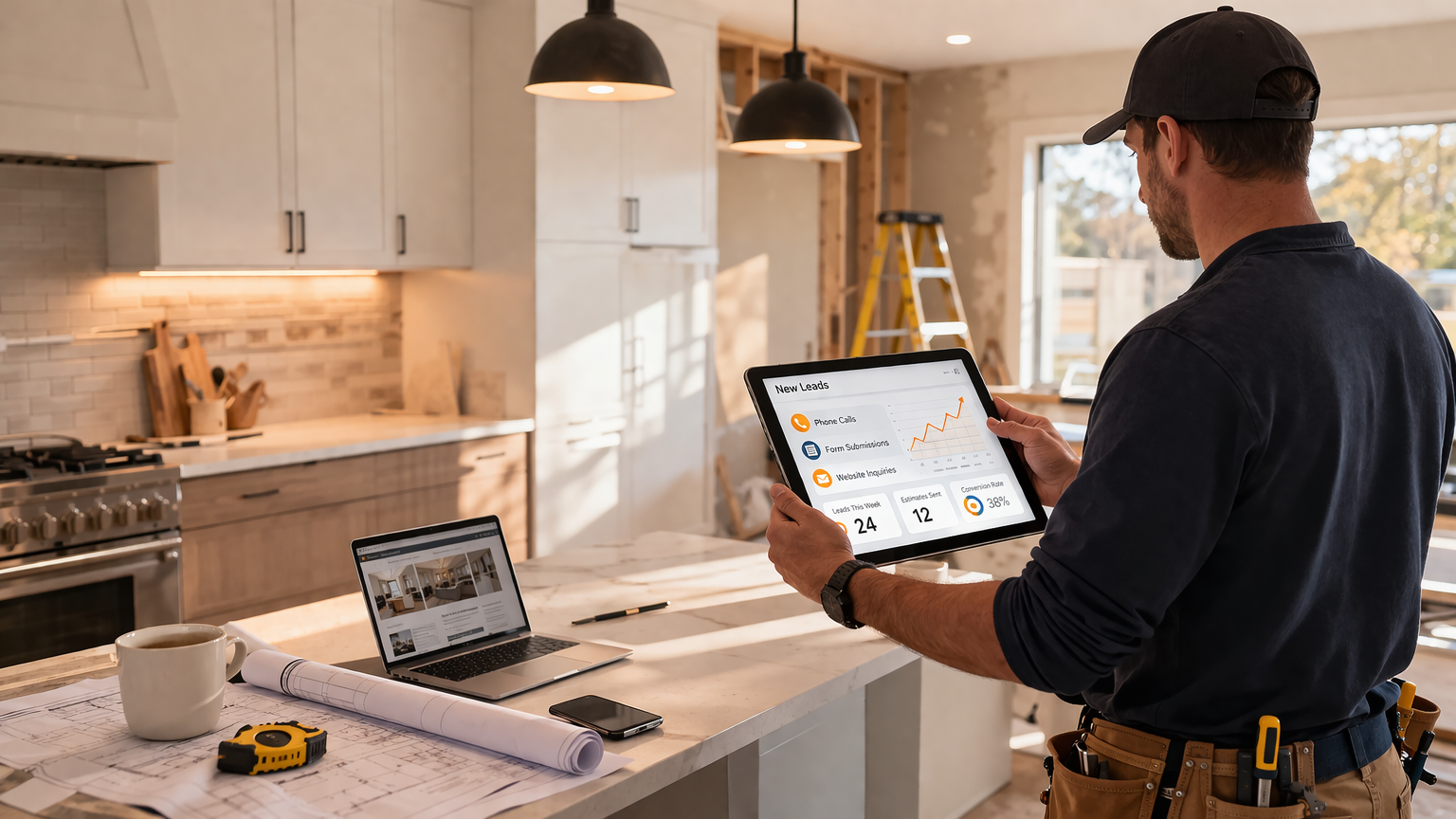
How to Get Kitchen and other Remodeling Leads: 6 Channels, Realistic Costs, and a 14-Day Mini Plan

Most remodeling contractors I talk to are burning money on ads that don’t work. They’re running Facebook campaigns with zero conversion tracking, calling Google Ads “too expensive,” or worse — they’re relying on referrals and wondering why revenue feels like a slot machine.
Here’s the truth: getting remodeling leads isn’t mysterious, but it does require a system. You need to know which channels actually move the needle for kitchens, bathrooms, and whole-home remodels. You need to understand what a qualified lead actually looks like. And you need to respond fast enough that you’re not competing against three other contractors.
This guide walks you through six proven channels for getting remodeling leads, what you should expect to pay, how to qualify them, and a practical 14-day plan you can start Monday morning. Want to skip the heavy lifting? Our platform handles lead generation for you.
What You’ll Get from This Article
- The 6 channels that actually generate remodeling leads (and why TikTok isn’t one)
- Realistic cost-per-lead benchmarks for each channel
- The definition of a qualified remodeling lead (and what to do when you get a bad one)
- A speed-to-lead SOP that keeps you ahead of competitors
- When to build in-house vs. hire an agency vs. use performance-based vendors
- A 14-day mini plan you can launch this week
Defining a Qualified Remodeling Lead
Before you chase leads, you need to agree on what one actually looks like. Because “a qualified lead” means something different to a kitchen remodeler in suburban Atlanta than it does to a bathroom specialist in Denver.
The Core Definition
A qualified remodeling lead has: (1) a specific project in mind (kitchen, bathroom, whole home), (2) a budget range they’ve communicated or we’ve qualified into, (3) a timeline (starting within 30-60 days is ideal for initial contact), and (4) decision-making authority. That last one matters. You don’t want to spend an hour with someone who’s “just gathering information” for a spouse who left for a business trip.
What kills most remodeling lead pipelines: contractors accept every inquiry as equal. A lead from Google Ads (intent, actively searching) is worth 3x a lead from a lead marketplace where someone filled out a form on a whim. Understanding this difference is core to how we deliver leads that actually convert.
Lead Replacement Rules
If a lead doesn’t meet your definition, you have three options: (1) adjust your targeting and channels to filter better upstream, (2) build a qualification call script that weeds them out faster, or (3) nurture them into qualified leads with a 6-8 week follow-up sequence. Most contractors do none of this and just get mad at the leads.
For remodeling specifically, expect that 30-40% of inbound leads won’t be qualified right away. Budget for nurture sequences, not just conversion. See real results from contractors who’ve built systems around this reality.
6 Channels for Getting Remodeling Leads
1. Google Search Ads (Google Ads)
This is the sniper rifle of lead generation. Someone types “kitchen remodeling near me” or “bathroom remodel cost” and you show up. The intent is there.
Cost per lead: $35–$80 depending on market size and competition. Dense metros (NYC, LA, Chicago) run $60–$100+. Smaller markets can be $20–$40.
What works: Tight keyword targeting (kitchen remodel, bathroom remodel, home remodeling contractor), location-based bid adjustments, lead form extensions or click-to-call. A/B test 3-4 different landing pages and let the algorithm sort winners.
Timeline to leads: First leads in 3-7 days. Ramp to 5-10 qualified leads per day in 3-4 weeks with a $2k/month budget.
Common mistake: Running broad match keywords (“remodeling,” “contractor”) instead of exact/phrase match. You’ll hemorrhage budget on tire-kickers. For a deeper dive into optimization, read our home improvement leads guide.
2. Local Service Ads (LSAs)
Google’s home services ads show up at the very top of search results with your reviews, license, and guaranteed response time. You only pay when someone calls or messages you.
Cost per lead: $15–$50 depending on how quickly you answer. Fast responders (under 2 minutes) see lower CPL because Google rewards conversion. Slow responders pay more or get deprioritized.
What works: A+ ratings (4.5+), verified reviews from past clients, quick response time. This is where speed-to-lead actually pays you back in cheaper leads.
Timeline to leads: Approval takes 5-10 business days. Once live, you can generate 5-15 leads per day depending on your local market.
The catch: LSAs are local-only. National or multi-state remodelers can’t rely on this alone, but for regional specialists, it’s gold.
3. Meta Ads (Facebook & Instagram)
Meta is better for remodeling than most contractors realize, especially for homeowners in the $25k–$150k renovation range. You’re targeting intent via interests and behaviors, not keywords.
Cost per lead: $10–$40 depending on creative quality and audience targeting. Bad creative (generic stock photos) runs $30+. Strong before-and-afters or client testimonial video: $10–$20. The difference mirrors what we see in case studies across our platform.
What works: Lead form ads (keep it to name, phone, project type). Audience targeting: homeowners aged 35-65, interests in home improvement, prior home-related purchases. Retargeting people who visited your website but didn’t convert.
Timeline to leads: First leads in 24 hours. Ramp to 10-20 leads per day in 2-3 weeks with a $1.5k/month budget.
The reality: Lower intent than Google, but cheaper and scale-friendly. Best for capturing people in the research phase.
4. SEO & Content Marketing
Articles like this one. Remodeling keywords have decent search volume and less competition than plumbing or HVAC. It takes 3-6 months to see real traffic, but once you rank, the cost per lead approaches zero.
Cost per lead: Amortized over 12 months, $2–$10 if you’re doing it in-house. $20–$50 if you’re hiring an agency.
What works: Pages targeting kitchen remodeling leads, bathroom remodeling leads, home remodeling costs, remodeling contractors near me. Internal linking connects readers to deeper resources like our home improvement leads guide. Target question-based keywords: “How much does a kitchen remodel cost?” “When should I remodel my bathroom?”
Timeline to leads: 3-6 months before meaningful volume. Then compounding. Not a fast channel, but it builds moat.
Real talk: This only works if you’re willing to wait or you hire professionals. Half-hearted blogging generates zero leads.
5. Partnerships & Referral Networks
Real estate agents, interior designers, property managers, and general contractors refer work constantly. Real money is in building formal partnerships, not hoping for crumbs.
Cost per lead: $100–$500 per referral (you pay a referral fee or split the job). But conversion rates are 50%+ because someone vetted them first.
What works: Identify 10-15 referral sources in your area (agents, designers, GCs). Meet with them. Give them a cut of the job (5–15% is standard). Make sure you deliver exceptional work so they keep referring.
Timeline to leads: 2-4 weeks to build relationships, 6-8 weeks before you see consistent referral flow. But once dialed in, it’s recurring and low-effort.
The hidden cost: You’re splitting profit. It’s worth it if your close rate and job margin are strong.
6. Lead Marketplaces & Aggregators
Angi (formerly Angie’s List), HomeAdvisor, Yelp, and others sell leads to contractors. You bid on projects in real-time or pay a subscription to access a lead pool.
Cost per lead: $15–$60 per lead, or $300–$1,500/month for unlimited access (quality varies wildly).
What works: Fast response time. Marketplaces rank contractors by response speed and completion rate. Reply in under 5 minutes and you’ll win more jobs. Use call + SMS + email simultaneously. If managing this yourself feels overwhelming, our process handles the qualification piece for you.
Timeline to leads: Instant. You’re connected the day you sign up.
The challenge: Low intent (form-fillers, tire-kickers). You’ll compete against 5-10 other contractors. Expect 10-20% close rates unless you nail speed and follow-up.
Lead Handling — The System That Makes or Breaks Your Numbers
Getting leads is half the battle. Converting them is where most contractors leave money on the table.
Speed-to-Lead SOP
Your response time directly impacts conversion. Studies show that leads contacted within 5 minutes are 100x more likely to convert than those contacted after 30 minutes.
Here’s the system: Lead comes in → automated SMS goes out within 60 seconds (template: “Hey [name], we got your request for [project]. Can we schedule a free consultation? Reply Y or call [#]”). → Your phone rings or SMS comes back within 2 minutes (if you can manage it). → Schedule call or in-home estimate for next 1-3 days.
If you can’t pick up, someone else does. No exceptions. Slack integration, CRM alerts, whatever. The contractors winning in this space have someone available 8am-8pm Monday–Saturday.
Call & SMS Scripts
Don’t wing it. Remodeling leads respond to structure:
Initial phone call (60 seconds max): “Hi [name], it’s [your name] with [company]. Thanks for reaching out about your [kitchen/bathroom]. Quick question — are you looking to start this spring or fall? ... Great. I’d love to show you some options. Are you free for a 20-minute consultation this Wednesday or Thursday?” Don’t pitch. Qualify and book.
SMS follow-up (if they don’t answer): “Hey [name]! Saw you’re looking for a [project type]. Quick questions: budget range and timeline? We’ve done 50+ in your area. Let’s chat brief call works best?”
The rule: Get off the phone and in front of them. A consultation (in-home or video) is worth 10 calls.
Build vs. Agency vs. Performance-Based
Three ways to generate remodeling leads. Each has trade-offs.
Not sure whether to buy leads or build your own pipeline? Read our buy vs. build guide for the full cost analysis.
Build In-House: You hire a marketing person (or contractor) to run Google Ads, manage LSAs, oversee SEO. Control, knowledge retention, flexibility. But: high fixed cost ($3k–$8k/month), you own all the risk, and they need to know remodeling (rare skill).
Hire an Agency: You outsource channels to a marketing firm. Good for moving fast and leaning on expertise. Trade-off: you pay agency markup (30-50% above media spend), less control, and you’re fighting for their attention if you’re a small client. Cost: $2k–$10k/month depending on scope. Alternatively, our lead generation platform gives you the results without the management headache.
Performance-Based (Lead Brokers): You pay per qualified lead delivered. Zero upfront risk—you only pay for results. Trade-off: higher per-lead cost ($50–$150 vs. $20–$40 with Google Ads), and you lose some control over messaging. But best for contractors who want predictable lead flow without marketing overhead.
Most scaling remodelers blend these: Run Google Ads + LSAs in-house or with an agency (lower CAC, higher control), supplement with performance-based leads during slower months or for underperforming service areas.
The 14-Day Mini Plan
You want to start now, not after a strategic planning meeting in Q3. Here’s what to do this week.
Days 1-3: Quick Wins & Setup
Monday morning: Audit your current leads. Which channels are you using? What’s the cost per qualified lead? What’s your response time right now? (If you don’t know, that’s problem #1.)
Claim & optimize your Google Business Profile. This feeds both Google Search and LSAs. Add 10+ photos of recent remodels, respond to all reviews within 24 hours, and make sure your service area is correct.
Tuesday: Set up basic Google Ads if you don’t have it. Start with 3-5 high-intent keywords (kitchen remodeling, bathroom remodeling, home remodel near me, whole house remodeling). Bid $2 per click, set a $50/day budget. Create 2 simple landing pages or use your homepage.
Wednesday: Build a lead response SOP. Who’s picking up the phone? What’s your response time target? Create an SMS template for instant follow-up. Share it with your team and commit to it.
Days 4-7: Scale One Channel
Focus on one channel only. If you already have Google Ads running okay, lean into it. If not, LSAs or Meta might be faster. Pick one, don’t dilute effort.
Google Ads path: Monitor daily. Pause underperforming keywords. Double down on keywords driving calls/conversions. Increase budget to $100/day if you’re getting leads. Track phone calls and form submissions in a spreadsheet (who, when, project type, estimated value).
LSA path: Apply for Google Local Services Ads if you haven’t. Get your license verified, upload 5-10 project photos, encourage past clients to leave reviews.
Meta path: Create 3 before-and-after carousel ads. Run lead form ads to a specific audience (homeowners, age 40-65, interests: home improvement, luxury home design). Start with $20/day budget. Track form submissions daily.
By day 7, you should have: At least 5-10 leads from your chosen channel, response time under 10 minutes for 100% of them, and a logged record of which ones are qualified. Compare your metrics against proven results from contractors using our platform.
Days 8-14: Double Down & Add a Second Channel
Optimize your first channel based on performance. What keywords/audiences drove qualified leads? Increase spend there. What didn’t work? Kill it and replace.
Add channel #2 strategically. If Google Ads is working, add LSAs. If Meta is working, add a partnership outreach program (email 10 real estate agents or designers with a partnership offer). If you’re generating 10+ leads, you can afford a second channel.
Track ruthlessly. Keep a simple sheet: Lead Source | Date | Contact | Project Type | Budget | Status (Qualified/Unqualified/In Progress/Won/Lost) | Notes. At day 14, you’ll see which channels are pulling their weight.
Timeline adjustment: If your first channel is generating 3-5 qualified leads per day, you’re on track. If you’re getting 20+ total leads but only 2-3 are qualified, your qualification process or targeting needs adjustment (not a channel problem).
Conclusion: Your Next Move
Most remodeling contractors don’t fail because they don’t know how to get remodeling leads. They fail because they either (1) try every channel at once and execute none well, (2) rely on one channel and panic when it dries up, or (3) generate leads but lose them to poor follow-up.
Pick one channel. Execute it hard. Respond fast. Qualify ruthlessly. Scale what works. That’s it. And if you’re in roofing, check our roofing lead generation guide for vertical-specific tactics.
If you want a shortcut: See how Pinecone Leads delivers qualified remodeling leads to your phone with zero setup time. Or if you want to talk through your specific situation, request a demo and we’ll walk you through it.
The contractors winning in 2026 aren’t the ones with the biggest budgets. They’re the ones with systems. Build yours this week.