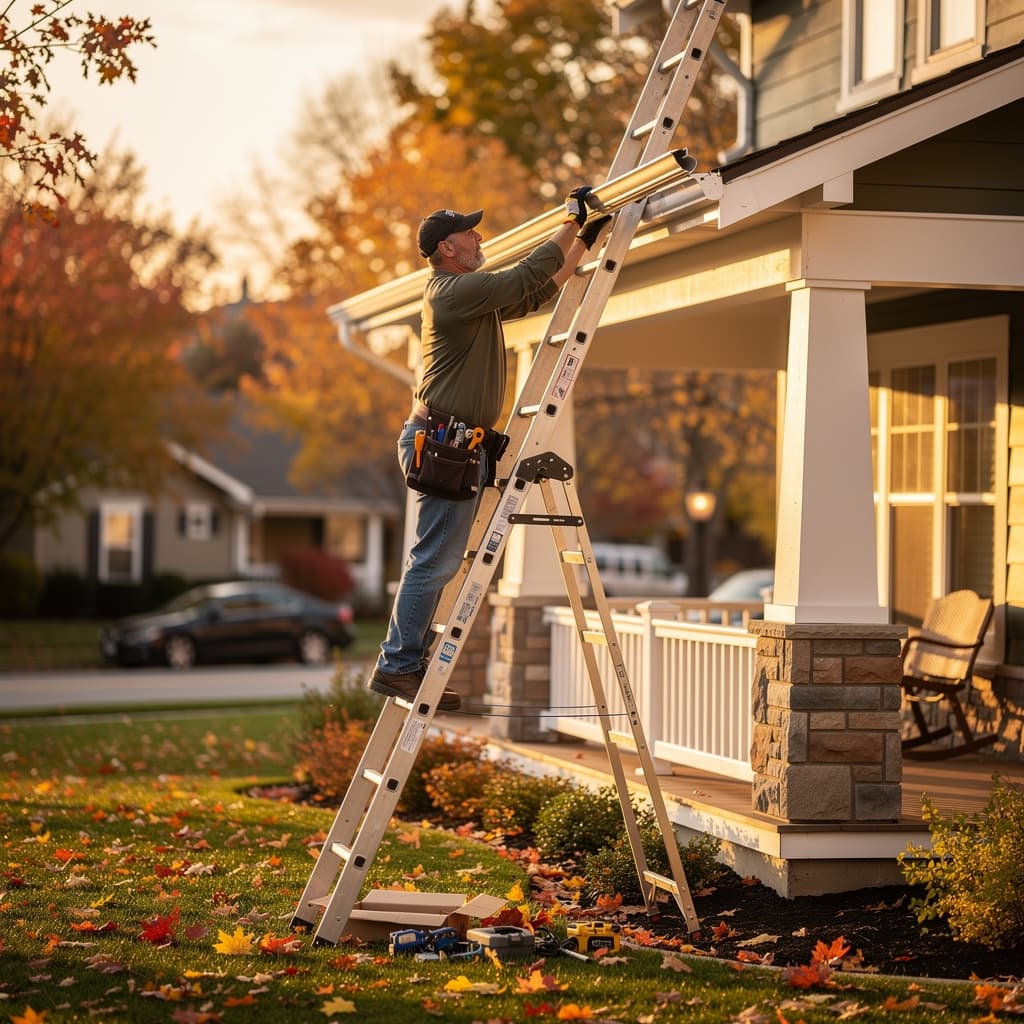
Why Gutter Leads Play by Different Rules
A roofing contractor buys a $150 exclusive lead and closes a $12,000 job. The math is clean — spend $150, make $12,000, repeat. Now picture a gutter cleaning contractor buying a $75 exclusive lead. The job pays $250. After labor, drive time, and the lead cost itself, the contractor pockets maybe $40.
That's not a lead generation strategy. That's a rounding error.
Gutter leads operate in a fundamentally different economic zone than roofing, HVAC, or window leads. The jobs are smaller — sometimes ten to forty times smaller — and buying premium exclusive leads for high-ticket closes simply doesn't translate. The contractors who build profitable businesses from gutter leads engineer volume, upsells, and recurring revenue into every lead they buy. What follows is how that math works — service by service, channel by channel, season by season — so you can build a gutter lead generation strategy that actually pencils out.
Three Gutter Services, Three Completely Different Businesses
The phrase "gutter leads" covers three distinct services with wildly different ticket sizes, margins, and customer lifetime values. Treating them the same is the fastest way to lose money on lead generation.
Gutter Cleaning: High Volume, Thin Margins
Most gutter cleaning jobs take one crew 45 minutes to two hours. Average ticket: $150–$350. Competition is fierce, homeowners price-shop aggressively, and a $50 shared lead on a $200 cleaning job leaves almost nothing after labor. Gutter cleaning leads only work when you're converting one-time customers into recurring maintenance contracts or upselling guards and repairs on the spot.
Gutter Installation: The Middle Ground
Average jobs land between $1,000 and $3,000 — enough margin to absorb a reasonable lead cost. Gutter installation leads behave like traditional home improvement leads: defined project, two or three competing bids, one-to-three-week decision window. A $75 exclusive lead on a $2,000 install starts to make sense.
Gutter Guards: The High-Ticket Play
Gutter guard systems — LeafFilter, MasterShield, micro-mesh installations — are the closest thing the gutter industry has to a "roofing-style" lead. Average jobs run $3,000–$8,000. Longer sales cycle, higher ticket, and homeowners who've already decided they're tired of climbing ladders twice a year. A $125 exclusive lead on a $5,000 guard installation delivers ROI that makes lead buying sustainable as a primary growth channel.
Your lead buying strategy should differ for each service. Blending all three into one "gutter leads" budget is like an HVAC company treating a $150 tune-up and a $12,000 system replacement as the same line item.
What Gutter Leads Actually Cost by Channel
Gutter lead costs run lower than most home improvement verticals because the job values are lower. But cheaper leads don't mean better economics — a $15 shared lead that never converts costs more than a $90 exclusive that books a job.
Below is what gutter contractors are paying across every major channel in 2026:
| Channel | Cost Per Lead | Avg Close Rate | Lead Type | Best For |
|---|---|---|---|---|
| Google LSA | $25–$65 | 30–45% | Exclusive | Cleaning + install |
| Google Search Ads | $35–$110 | 12–22% | Exclusive (self-gen) | Guard systems, install |
| Exclusive Lead Providers | $40–$125 | 25–40% | Exclusive | Install + guard |
| Shared Marketplaces (Angi, Thumbtack) | $15–$55 | 4–10% | Shared (3–5 buyers) | Volume cleaning |
| Meta Ads (FB/IG) | $20–$75 | 8–15% | Exclusive (self-gen) | Seasonal cleaning pushes |
| Nextdoor Ads | $15–$45 | 10–18% | Exclusive (self-gen) | Neighborhood cleaning runs |
| SEO / Google Business Profile | $0 (time investment) | 25–40% | Exclusive | All services long-term |
| Referrals / Repeat Customers | $0–$25 | 50–70% | Exclusive | Recurring maintenance |
Two patterns stand out. Google LSA is the best-performing paid channel for gutter work — homeowners searching "gutter cleaning near me" are ready to book, not browse. And shared marketplace leads at $15–$55 look cheap, but a 4–10% close rate on a $250 cleaning job means you're spending $150–$1,375 to acquire a single customer. That only works if you're converting them into something bigger downstream.
Thumbtack's instant-match feature prioritizes contractors who respond within minutes, so gutter leads for contractors without a fast follow-up system go to competitors before they even see the notification. Automate your response or don't bother.
For a broader look at how lead providers compare across all home improvement trades, see our comparison of the best lead generation companies for contractors.
Why the Standard Exclusive Lead Playbook Breaks for Gutter Cleaning
The exclusive lead model works beautifully for trades with $5,000+ average jobs. You pay $75–$200, close 25–35%, and the revenue per closed deal is ten to fifty times your lead cost.
Gutter cleaning destroys that math.
Buy exclusive gutter cleaning leads at $50 each. Close rate: a solid 30%. Cost to acquire a customer: $167. The job pays $250. After labor ($80), drive time ($20), and materials ($10), gross profit before lead cost is $140. Subtract the $167 acquisition cost — you're at negative $27 per acquired customer. You closed the job. You did the work. You lost money.
This is the trap that catches contractors who apply advice designed for roofers or HVAC companies. So what actually works?
- Buy shared leads for cleaning work. At $15–$25 per lead, you can afford the lower conversion. A 7% close rate at $20/lead means $286 to acquire a customer — still negative on a single cleaning job, but read the next section before you give up.
- Reserve exclusive leads for install and guard work. A $75 exclusive lead on a $2,500 install with a 30% close rate means $250 cost per acquired customer — leaving $700+ in gross profit. Sustainable. For more on when shared vs. exclusive makes sense, see our detailed comparison.
- Generate your own cleaning leads through LSA and SEO. Google LSA leads for gutter cleaning run $25–$40 with 35–45% book rates — a $56–$114 acquisition cost. Tight on a $250 job, but workable with efficient operations.
- Treat every cleaning lead as a guard or install prospect first. This is the real unlock.
How to Make Gutter Leads Profitable: The Upsell Math
The gutter contractors who profit from lead buying don't make their money on the first job. They make it on what happens during and after that first visit.
A cleaning lead that costs $20 and closes a $250 job is break-even at best. That same $20 lead closing a $250 cleaning plus a $4,500 gutter guard upsell? Suddenly your best-performing marketing channel.
Scenario 1: Cleaning Only (No Upsell Strategy)
100 shared leads x $20 = $2,000 lead spend. Close rate: 8%. Jobs closed: 8. Revenue: $2,000 (8 x $250). Gross profit after labor: $1,120. Net after lead cost: -$880. You lost money.
Scenario 2: Cleaning + Upsell Pipeline
Same 100 leads, same $2,000 spend, same 8 cleaning jobs. But your crew inspects every gutter system and presents options:
3 of 8 customers buy gutter guards on the spot or within 30 days (37% upsell rate). Average guard job: $4,000. Additional revenue: $12,000. Another 2 need section replacements at roughly $800 each — $1,600. And 5 of 8 sign up for twice-yearly maintenance at $200/year, adding $1,000 in year-one revenue that recurs without any lead cost.
Total revenue from those same 8 cleaning leads: $16,600. Gross profit after labor and materials: roughly $8,900. Net after $2,000 lead spend: $6,900. Same leads. Same spend. Completely different business.
One contractor in our network went from $180K to $420K in annual revenue over 18 months by adding guard installation to his cleaning-only operation — without increasing his lead volume. The entire jump came from training his two-man crew to photograph damage, present guard options on a tablet, and offer same-day pricing. His gutter lead generation costs stayed flat while revenue more than doubled.
The Three Upsell Moves Every Gutter Crew Should Make
Before cleaning, photograph sagging sections, rusted brackets, damaged downspouts, and clogged underground drains. Show the homeowner on a tablet before you leave.
Present gutter guards as a cost comparison, not a product pitch: "You've been paying $250 twice a year for three years — $1,500 so far. Guards are a one-time $4,000 and you never need cleaning again." Frame it as math, not sales.
Offer a same-day install discount on guards — 10–15% off if they commit while you're on-site. Eliminates the second truck roll and captures the customer while motivation is highest.
A 30–40% upsell rate from cleaning to guards isn't aspirational. It's what we see from contractors in our network who train crews to have this conversation on every job.
Want exclusive leads for your trade?
Pay only for qualified leads. 14-day ROI guarantee.
Seasonal Patterns: When Gutter Lead Volume Spikes (and Crashes)
Gutters are the most seasonally concentrated trade in home improvement. Fall dominates everything. If you're not prepared for the September-through-November surge, you'll overpay for leads or miss the biggest revenue window of the year.
The Gutter Lead Calendar
January through March is the dead zone for cleaning. Install and guard interest stays moderate as homeowners start spring project research. Lead costs bottom out — smart contractors lock in annual commitments with providers at lower per-lead rates during this window.
April and May bring the spring cleaning bump. Moderate volume, moderate pricing. Facebook ads for cleaning specials perform well here, with CPLs running 20–30% below fall peaks.
June through August is the slowest period for gutter cleaning leads. Install and guard work carries the summer. Rain gutter leads for new construction pick up in markets with active building seasons.
September through November is the gold rush. Gutter cleaning leads spike 200–400% above summer levels. Lead costs jump 30–50%, but volume makes up for it — run every crew you have, six or seven days a week. Google Trends data for "gutter cleaning near me" shows the same pattern annually: search volume triples between August and October, then drops off a cliff by December.
December brings emergency calls from ice dams and frozen downspouts in cold climates. Lower volume but high urgency — homeowners pay premium rates, and these leads close fast.
How to Play Seasonality
Pre-book your fall lead capacity with providers in July or August, before competitors claim inventory. Run Facebook and Nextdoor campaigns in April targeting "spring gutter cleaning" — less ad competition than October. Use the winter slowdown to invest in SEO; ranking for "gutter cleaning near me" by September is worth more than any paid campaign during peak. Push guard installations in spring and summer when cleaning volume is low — higher-ticket jobs keep revenue steady during slow months.
Scaling Math: Building a $500K Gutter Business From Leads
What does it take to hit $500,000 in annual revenue using paid leads as a primary growth channel? Working backward from that target reveals why service mix matters more than lead volume.
The Service Mix That Makes $500K Work
A pure cleaning business hitting $500K needs roughly 2,000 jobs per year at $250 average — 8 jobs per day, 250 working days. Possible with two to three crews, but the lead pipeline would be enormous and margins razor-thin.
A blended model gets there with far fewer leads:
- 800 cleaning jobs x $275 avg = $220,000
- 60 gutter installations x $2,200 avg = $132,000
- 25 gutter guard systems x $5,200 avg = $130,000
- Maintenance contracts (200 active) x $200/yr = $40,000 recurring
Total: $522,000. And 35–40% of those install and guard jobs come from upselling cleaning customers — your cleaning pipeline feeds them without buying separate gutter installation leads or gutter guard leads for every high-ticket job.
The Lead Budget
To generate 800 cleaning jobs at a blended 15% close rate (shared leads, LSA, and organic), you need roughly 5,300 cleaning leads per year. At a blended $18/lead, that's $95,400 in cleaning lead spend.
For the 35–40 install and guard jobs you can't source from upsells, budget exclusive leads: 140 leads x $80 average = $11,200.
Total annual lead budget: approximately $107,000 — about 20% of revenue. In line with what successful home service companies spend on acquisition. For context on how other trades structure lead budgets, see our guide on buying vs. building contractor leads.
The Key Levers
Upsell rate. If your cleaning-to-guard conversion drops from 35% to 15%, you need twice as many guard-specific leads at $100+ each. Lead budget jumps $15K–$20K and margins shrink.
Speed-to-lead. Gutter cleaning is a commodity service. The contractor who calls back in two minutes books the job; two hours later, they don't. A CRM like Jobber or Housecall Pro with automated text confirmations cuts response time from hours to seconds — for gutter leads, that speed difference is the gap between a 15% close rate and a 35% one. Ninety-second response isn't aspirational — it's required.
Maintenance contract enrollment. Every cleaning customer on a $200/year agreement is a customer you never buy again. At 200 active contracts, that's $40,000 in annual revenue with zero lead cost. After three years, those contracts alone could cover your entire overhead.
Where to Start If You're Buying Gutter Leads for the First Time
Don't try to build the full machine on day one. Start with the channel that matches your current service mix.
Primarily a cleaning company? Start with Google LSA. Get verified, collect reviews aggressively, aim for the top three in your market. Supplement with shared marketplace leads from Angi or Thumbtack at $15–$30 each — but only if you have an upsell process in place.
Already doing install and guard work? Start with an exclusive lead provider. Target $40–$125 per lead, aim for 25%+ close rate. Make sure the provider filters by service type — you don't want to pay $100 for a cleaning inquiry when you're tooled for $5,000 guard installs.
Building from scratch? Open with LSA plus one shared marketplace. Use the first 90 days to dial in close rate, upsell pitch, and response time. Once your numbers stabilize, add an exclusive provider for install and guard leads. Build SEO in parallel — it won't pay off for four to six months, but once it does, those leads are free forever. For a broader view on mixing paid and organic, see our guide to getting home improvement leads.
Track cost per acquired customer by service type from day one. Not cost per lead — cost per customer. A tool like ServiceTitan lets you tag every lead by source and service type, then track through to the closed invoice — so you know exactly which channels produce profitable gutter leads for contractors in your market and which ones just look busy. That's the only number that tells you whether your gutter lead generation is working or slowly bleeding cash. And if you want a partner who sends exclusive, performance-based leads without long-term contracts, reach out to our team to see if your market is available.
Frequently Asked Questions About Gutter Leads
How much do gutter leads cost?
Between $15 and $125 per lead, depending on channel and exclusivity. Shared marketplace leads: $15–$55. Exclusive providers: $40–$125. Google LSA: $25–$65. The real number to watch is cost per acquired customer — a $15 lead with a 5% close rate is more expensive than a $65 lead that closes at 35%.
Are gutter leads worth buying?
For installation and guard work, yes — the ticket size supports it. For cleaning-only operations without an upsell process, rarely. Contractors in our network who profit from gutter leads consistently have a cleaning-to-guard upsell rate above 25%.
What's the best source for gutter cleaning leads?
Google LSA. It combines the lowest cost per booked job with the highest close rate of any paid channel for gutter cleaning. Homeowners using LSA are searching with intent — they want to book this week, not compare six providers over the next month.
How do I get more rain gutter leads in fall?
Pre-book capacity with your lead providers by August. Launch Facebook and Nextdoor campaigns targeting "fall gutter cleaning" in early September, before every competitor floods those channels in October.
Can I build a full gutter business on purchased leads alone?
You can, but it gets expensive. The most profitable gutter businesses blend purchased leads (40–50% of customers) with organic search, referrals, and maintenance contract renewals. Running 100% on purchased leads means 25–30% of revenue goes to acquisition — workable, but thin margins and zero buffer if lead costs spike.
What close rate should I expect on gutter leads?
Shared marketplace leads: 4–10%. Exclusive provider leads: 25–40%. Google LSA: 30–45%. Below those ranges, the problem is usually speed-to-lead or phone process — not lead quality.